Introduction
The Private Security Agencies Regulation Act (PSARA) license is mandatory for running a private security agency in India. However, many agencies face PSARA rejection due to minor mistakes, incomplete documents, or lack of compliance with legal requirements.
A rejected PSARA application not only delays your business plans but can also increase costs and create legal complications. The good news is that in most cases, rejection is not permanent—you can fix the issues and reapply successfully.
In this blog, we will explain the top PSARA license rejection reasons, real-life examples, and the step-by-step PSARA re-application process, so you can avoid mistakes and get approval smoothly with the help of top PSARA consultants in Jaipur.
What is PSARA License and Why is It Important?
A PSARA license is issued under the Private Security Agencies Regulation Act, 2005. It ensures that private security agencies operate legally and follow government rules.
Without a PSARA license, running a security agency is illegal and can lead to penalties, business shutdown, or legal action.
Understanding the PSARA license process is the first step to avoiding rejection.
Top Reasons for PSARA License Rejection
Let’s look at the most common reasons why PSARA applications get rejected:
1. Incomplete or Incorrect Documentation
One of the biggest reasons for PSARA rejection is missing or incorrect documents.
Common issues include:
- Wrong company registration details
- Missing MoU with training institute
- Incorrect address proof
- Invalid identity documents of directors/partners
💡 Tip: Always verify documents with best PSARA consultants in Jaipur before submission.
2. Police Verification Failure
Police verification of directors, partners, and key personnel is mandatory.
Your application may be rejected if:
- Any director has a criminal record
- Address mismatch in documents
- Negative police report
This is one of the most sensitive stages in the PSARA license process.
3. Non-Compliance with Training Requirements
According to PSARA rules, agencies must have an MoU with a government-recognized training institute.
Rejection happens when:
- The training institute is not recognized
- MoU format is incorrect
- Training details are incomplete
4. Improper Company Structure
Your company must be properly registered as:
- Private Limited Company
- LLP
- Partnership Firm
- Sole Proprietorship (in some states)
If your business structure does not meet PSARA norms, your application may face rejection.
5. Financial and Tax Compliance Issues
Authorities also check:
- GST registration
- Income tax returns
- Bank statements
- Financial stability
If your agency fails to meet financial criteria, it may lead to PSARA rejection.
6. Incorrect Application Form or Errors in Details
Even small mistakes like spelling errors, mismatched names, or wrong dates can result in rejection.
This is why professional guidance from Jaipur PSARA consultants is highly recommended.
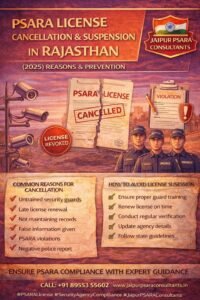
7. PSARA Suspension Due to Violations
Sometimes, agencies face PSARA suspension after approval due to:
- Violation of PSARA rules
- Fake documents
- Non-compliance with training norms
- Misconduct by security guards
Suspension can also lead to cancellation if issues are not resolved.
Real-Life Examples of PSARA Rejection
Example 1: Document Mismatch
A security agency in Jaipur applied for a PSARA license but used a rented office address without proper rent agreement and NOC from the landlord.
Result: Application rejected due to address verification failure.
After correcting documents with the help of top PSARA consultants in Jaipur, the agency successfully got approval in the second attempt.
Example 2: Police Verification Issue
A director had an old pending legal case that was not disclosed in the application.
Result: Negative police report and PSARA rejection.
After legal clarification and proper disclosure, the agency reapplied and got approval.
Example 3: Wrong MoU with Training Institute
An agency signed an MoU with an unrecognized training center.
Result: Application rejected.
After signing a valid MoU with a recognized institute, the license was approved.
Step-by-Step PSARA Re-Application Process
If your PSARA license is rejected, follow this process:
Step 1: Identify the Exact Reason for Rejection
Carefully review the rejection notice issued by the authority.
Step 2: Rectify Errors and Gaps
Fix issues such as:
- Missing documents
- Incorrect details
- Compliance gaps
Step 3: Update Documents and Compliance
Ensure:
- Valid MoU
- Clear police verification
- Proper company registration
- Updated financial records
Step 4: Reapply Through Proper Channel
Submit the corrected application with all required documents.
Step 5: Follow Up with Authorities
Regular follow-up is important to avoid delays.
Professional support from best PSARA consultants in Jaipur can significantly increase approval chances.
How Professional PSARA Consultants Help Avoid Rejection
Hiring experienced consultants can help you:
- Understand the complete PSARA license process
- Prepare accurate documents
- Avoid common mistakes
- Handle police verification smoothly
- Manage PSARA suspension and re-application
That’s why many agencies prefer working with Jaipur PSARA consultants instead of applying on their own.
FAQs – PSARA License Rejection & Re-Application
1. Can I reapply after PSARA rejection?
Yes, you can reapply after correcting the issues mentioned in the rejection notice.
2. How long does the PSARA re-application process take?
It usually takes 30 to 90 days, depending on state authorities and document verification.
3. Is PSARA suspension different from rejection?
Yes. Rejection happens during application, while PSARA suspension occurs after license approval due to violations.
4. Can a rejected PSARA application be approved later?
Yes, if all compliance issues are resolved properly.
5. Why should I hire top PSARA consultants in Jaipur?
Professional consultants reduce rejection risk and ensure faster approval through proper documentation and compliance.
Conclusion
PSARA license rejection is common but avoidable. Most rejections happen due to small mistakes, incomplete documents, or lack of compliance with PSARA rules.
If you understand the PSARA license process and take professional guidance from top PSARA consultants in Jaipur, you can easily avoid PSARA rejection and even recover from PSARA suspension.
A well-prepared application not only saves time and money but also ensures smooth approval for your security agency business.
If you are planning to apply or reapply for a PSARA license, make sure you follow the correct process or consult experienced Jaipur PSARA consultants for hassle-free approval.