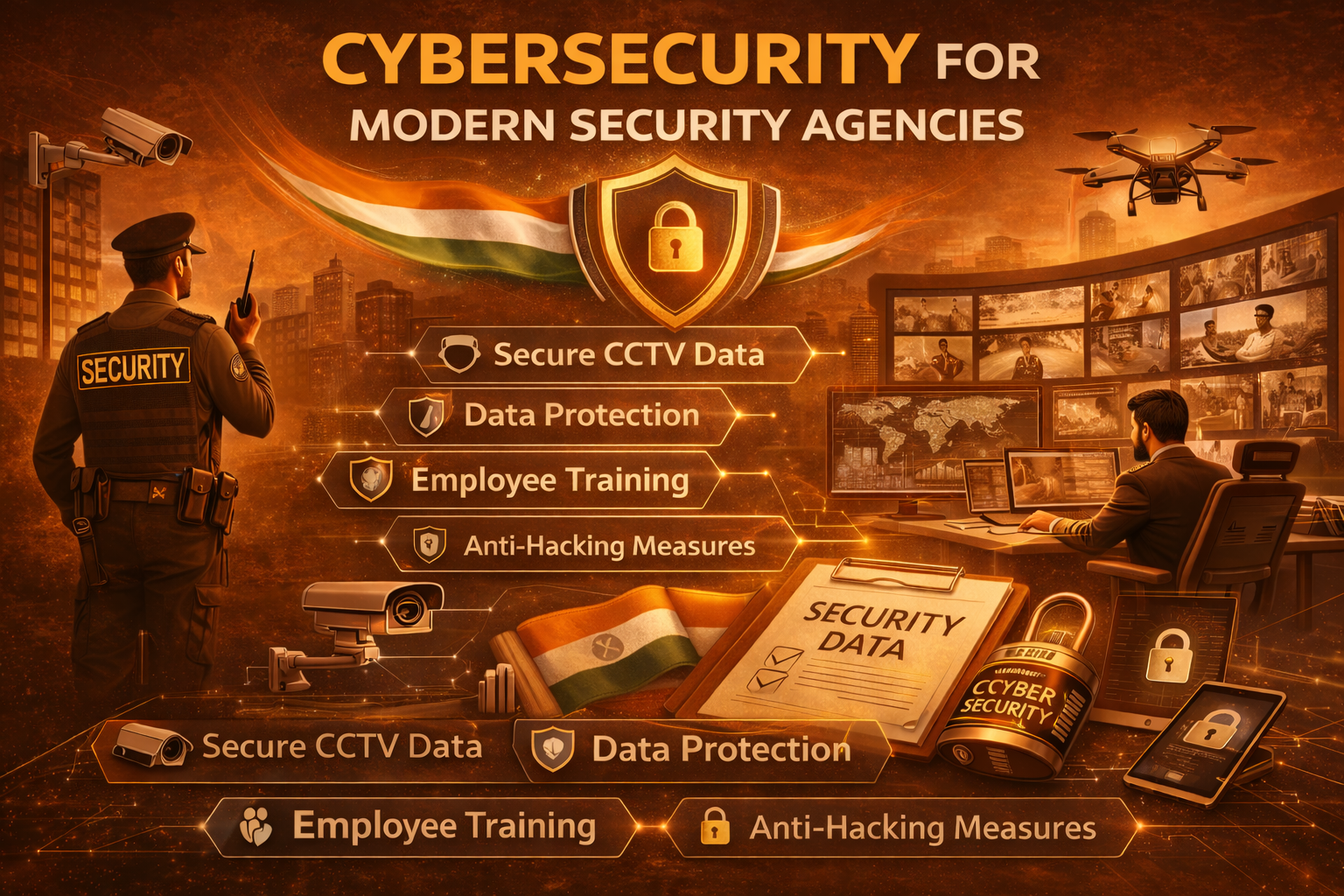
A Complete Guide for Security Companies in the Digital Era
The security industry is no longer limited to guards, uniforms, and physical protection. Today, modern security agencies handle sensitive client data, CCTV footage, biometric records, GPS tracking systems, and digital attendance platforms.
While agencies focus heavily on compliance under the Private Security Agencies Regulation Act (PSARA Act 2005), one major risk is often ignored — cybersecurity.
In today’s digital world, protecting data is just as important as protecting property.
Let’s understand why cybersecurity is becoming critical for modern security agencies and how it connects with PSARA Rues, compliance, and long-term business growth.
📌 Why Cybersecurity Matters for Security Agencies
Security agencies deal with highly sensitive information such as:
- Client building layouts
- CCTV surveillance footage
- Guard deployment details
- VIP protection schedules
- Employee ID proofs & background verification records
- Biometric attendance data
If this data is hacked, leaked, or misused, the consequences can be serious:
- Loss of client trust
- Legal action
- Contract termination
- Reputation damage
- Problems during PSARA Renewal
In simple words, if your digital security fails, your business security also fails.
🔐 How Cybersecurity Connects with PSARA Compliance
Under PSARA Act 2005, agencies must:
- Maintain proper employee records
- Conduct background verification
- Maintain operational discipline
- Follow state-level PSARA Rues
Although the Act primarily regulates manpower-based security, modern interpretation of compliance includes safe handling of records and confidential information.
If authorities inspect your agency and find poor documentation control or data mismanagement, it may impact your compliance record and future PSARA Renewal.
🚨 Major Cybersecurity Risks for Security Agencies
1️⃣ CCTV Data Breach
Many agencies manage remote CCTV monitoring for clients. If the system is hacked:
- Live footage can be leaked
- Client premises may be exposed
- Legal liability may arise
2️⃣ Biometric Data Theft
Modern agencies use biometric attendance systems. If hacked:
- Employee data can be stolen
- Identity misuse can happen
- Legal issues may arise
3️⃣ Email & Invoice Fraud
Hackers sometimes send fake emails pretending to be company representatives.
Result?
Clients transfer payments to fraudulent accounts.
4️⃣ GPS & Patrol Tracking Manipulation
Advanced agencies use GPS tracking for guards and vehicles. If hacked:
- Deployment routes can be manipulated
- Security operations may be compromised
📖 Real-Life Examples
Example 1: CCTV Server Hacked
A mid-sized security agency stored CCTV footage on an unsecured server. Hackers accessed footage from a corporate office and demanded ransom.
The client immediately terminated the contract and filed a legal complaint.
Lesson: Basic password protection is not enough.
Example 2: Fake Payment Email Scam
A security agency’s email system was compromised. Fraudsters sent payment instructions to a client, and ₹8 lakhs were transferred to the wrong account.
The agency faced both financial loss and reputation damage.
Lesson: Cybersecurity is business security.
🛡️ Essential Cybersecurity Measures for Security Agencies
✅ 1. Use Secure Cloud Storage
Store CCTV footage and sensitive data on encrypted cloud platforms instead of unsecured local drives.
✅ 2. Strong Password & Multi-Factor Authentication
Use:
- Complex passwords
- Two-factor authentication (OTP-based login)
- Restricted admin access
✅ 3. Regular Software Updates
Outdated software is the biggest security weakness.
Keep:
- CCTV systems updated
- Attendance software updated
- Antivirus active
✅ 4. Employee Cyber Awareness Training
Just like physical training under PSARA Rues, agencies must train staff on:
- Phishing email detection
- Password safety
- Safe data sharing
✅ 5. Data Access Control
Not every employee should have access to:
- Client data
- Deployment plans
- Financial records
Limit access strictly.
📊 Cybersecurity & Business Growth
Corporate and government clients now ask:
- How do you store our CCTV data?
- Is your system encrypted?
- Do you follow data protection standards?
Agencies that implement strong cybersecurity measures gain:
✔ Higher client trust
✔ Better contract opportunities
✔ Competitive advantage
✔ Stronger compliance record
This is where consultation from professionals, including the Top CA for PSARA License, helps integrate cybersecurity compliance with financial and legal systems.
🔄 Cybersecurity & PSARA Renewal
Many agencies do not realize that poor record management can affect PSARA Renewal.
During inspections, authorities may review:
- Record maintenance
- Employee verification data
- Documentation process
If data is lost or compromised, it reflects weak management.
The Best CA for PSARA License often advises agencies to maintain structured documentation systems to avoid issues during renewal.
⚠️ Common Mistakes Security Agencies Make
❌ Using shared passwords
❌ Storing client data on personal laptops
❌ No data backup system
❌ No written cybersecurity policy
❌ Ignoring IT audits
These small mistakes can cause major damage.
🔮 The Future: Cyber + Physical Security Integration
The future of the security industry will combine:
- Physical guards
- AI surveillance
- Cloud-based monitoring
- Digital reporting
- Integrated compliance systems
Agencies that invest in cybersecurity today will dominate tomorrow.
Under evolving PSARA Rues and stricter enforcement of PSARA Act 2005, documentation and data management will become even more important.
❓ Frequently Asked Questions (FAQs)
1. Is cybersecurity mandatory under PSARA Act 2005?
The Act mainly regulates manpower, but safe record management and operational discipline indirectly require proper data protection.
2. Can poor cybersecurity affect PSARA Renewal?
Yes. If records are lost, manipulated, or compromised, it may impact compliance review during PSARA Renewal.
3. What is the biggest cyber risk for security agencies?
CCTV data breaches and email fraud are among the most common threats.
4. Do small security agencies need cybersecurity systems?
Absolutely. Even small agencies handle sensitive client and employee data.
5. How can agencies strengthen compliance?
By combining:
- Proper documentation
- Cybersecurity systems
- Legal compliance under PSARA Rues
- Professional guidance from the Top CA for PSARA License
🏁 Conclusion
The role of a security agency is to protect others. But in today’s digital world, agencies must also protect their own systems and client data.
Cybersecurity is no longer optional — it is a business necessity.
As regulations under the Private Security Agencies Regulation Act, 2005 continue to evolve, agencies must focus on:
✔ Strong digital infrastructure
✔ Data protection policies
✔ Regular system audits
✔ Timely PSARA Renewal
✔ Professional compliance management
Consulting the Best CA for PSARA License can help integrate financial, legal, and cybersecurity compliance into one structured system.