
A Practical Guide for Security Agency Owners
The private security industry in India has grown rapidly over the last decade. From residential societies and malls to IT parks and government institutions, trained security personnel are now an essential part of daily operations.
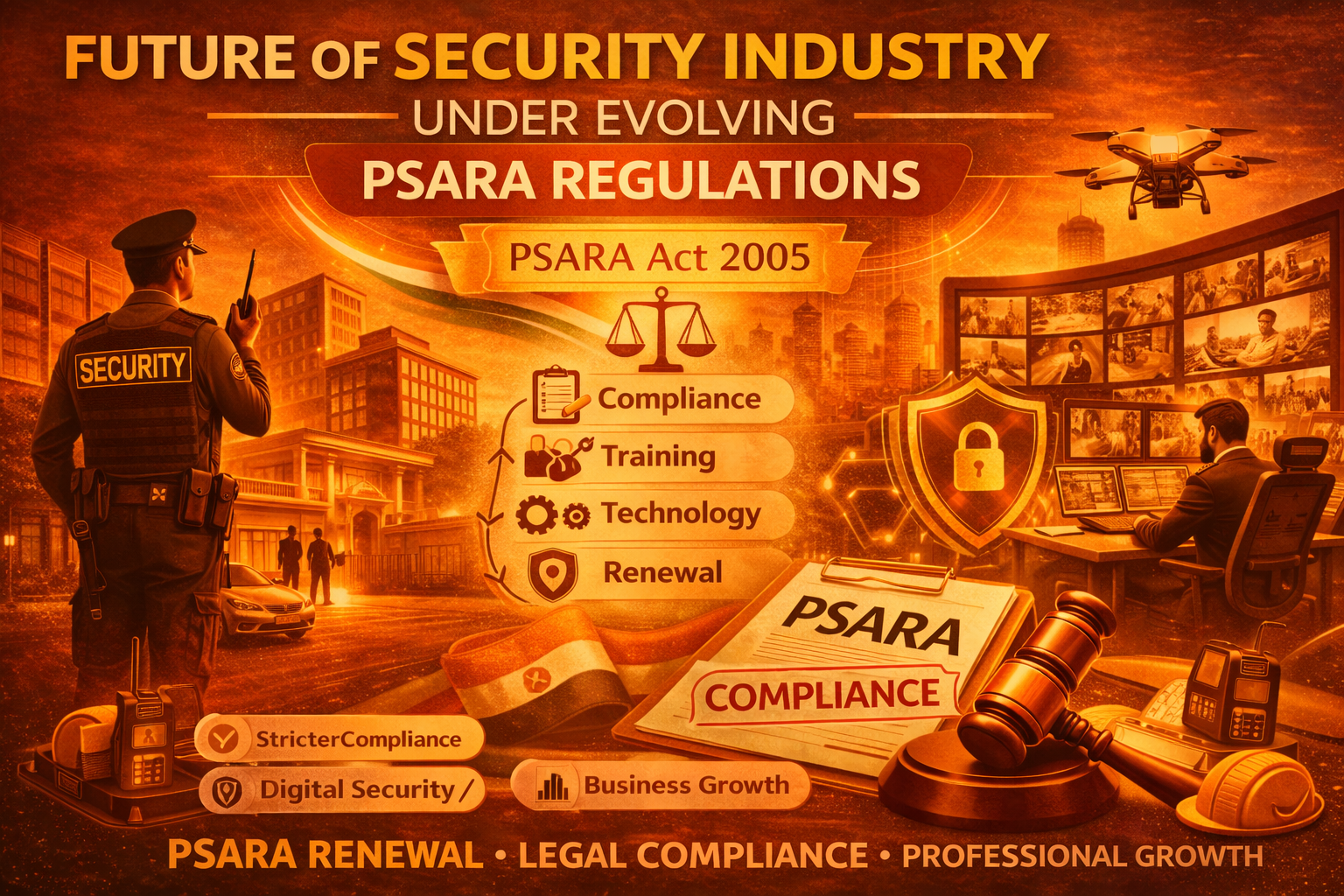
This entire industry operates under the framework of the Private Security Agencies Regulation Act (PSARA Act 2005). While the Act was introduced to regulate and standardize security agencies, evolving business models, technology integration, and stricter compliance monitoring are reshaping how agencies function.
So the big question is: What does the future look like for the security industry under evolving PSARA Regulations (PSARA Rues)?
Let’s break it down in simple and practical language.
📌 Introduction: Why PSARA Regulations Are Becoming More Important
Earlier, many small agencies operated casually with minimal documentation. Today, clients demand:
- Valid PSARA License
- Proper police verification
- Trained security guards
- Statutory compliance (PF, ESI, minimum wages)
- Clean compliance record for PSARA Renewal
At the same time, state authorities are tightening scrutiny. Compliance is no longer optional — it is a business necessity.
The future of the industry will belong to agencies that are:
✔ Fully compliant
✔ Professionally managed
✔ Digitally organized
✔ Legally updated
🚀 Major Trends Shaping the Future of the Security Industry
1️⃣ Stricter Compliance Monitoring
Authorities are increasingly verifying:
- Training records
- Guard background checks
- Uniform standards
- Timely filing of annual returns
- Proper documentation for PSARA Renewal
Non-compliance may result in suspension or cancellation.
In the future, compliance audits may become more frequent, especially in metro cities and industrial hubs.
2️⃣ Technology Integration in Security Services
Modern security is no longer just about guards standing at gates.
Security agencies are now integrating:
- CCTV surveillance
- Access control systems
- Biometric attendance
- AI-based monitoring
- Drone surveillance
While PSARA Act 2005 primarily regulates manpower-based security, agencies must align technology usage with legal guidelines and client data protection standards.
Future-ready agencies will combine manpower + technology.
3️⃣ Increased Demand for Trained & Certified Guards
Clients today expect:
- Soft skills training
- Emergency response knowledge
- Fire safety awareness
- First aid certification
- Basic IT skills
PSARA Rues already mandate training requirements, but enforcement is becoming stricter.
Agencies that invest in structured training programs will dominate the market.
4️⃣ Multi-State Expansion & Complex Compliance
Many agencies now want to operate in multiple states.
However:
- Separate PSARA licenses are required state-wise
- Rules differ slightly from state to state
- Documentation requirements vary
Future growth will require proper structuring, compliance management systems, and professional guidance from the Top CA for PSARA License to avoid legal complications.
5️⃣ Corporate Governance & Professional Management
Small family-run agencies are gradually transforming into:
- Private Limited Companies
- LLP structures
- Organized enterprises
Corporate clients prefer agencies that have:
- Transparent accounting
- Legal compliance
- Timely PSARA Renewal
- Clean audit history
This is where consulting the Best CA for PSARA License becomes crucial for long-term growth.
📖 Real-Life Examples
Example 1: Non-Compliant Agency Lost Corporate Contract
A mid-sized agency failed to maintain proper training records and delayed PSARA Renewal. During client audit, they could not provide proper documentation.
Result?
The corporate client terminated the contract and shifted to a compliant agency.
Lesson: Future contracts will depend heavily on documentation and compliance.
Example 2: Tech-Enabled Agency Grew Rapidly
Another security agency invested in:
- Digital attendance systems
- Guard tracking apps
- Structured training modules
- Regular annual return filings
Because of their clean compliance under PSARA Act 2005, they qualified for government tenders and expanded to three states within 4 years.
Lesson: Compliance + Technology = Growth.
🔮 What Will the Future Look Like?
Here’s what we can expect in coming years:
✔ Digital Filing & Online Monitoring
States may introduce more online portals for filing returns and renewals.
✔ Stricter Penalties for Non-Compliance
Authorities may impose stronger action against unlicensed operations.
✔ Greater Professionalization
Only serious, organized, and legally compliant agencies will survive.
✔ Integration with Labour & Tax Compliance
PSARA compliance will increasingly align with:
- PF
- ESI
- GST
- Income Tax
This is why agencies are now consulting experienced professionals and the Top CA for PSARA License to manage integrated compliance.
⚠️ Key Challenges Agencies Must Prepare For
- Increasing compliance costs
- Training expenses
- Digital transformation investment
- Competition from organized players
- Frequent regulatory updates
Ignoring these changes can be risky.
🧾 Role of Professional Advisors in the Future
As regulations evolve, professional guidance becomes essential.
The Best CA for PSARA License can help with:
- Structuring your company properly
- Filing annual returns accurately
- Handling notices from authorities
- Managing PSARA Renewal smoothly
- Integrating tax and statutory compliance
In the future, agencies without proper advisory support may struggle.
❓ Frequently Asked Questions (FAQs)
1. Will PSARA rules become stricter in the future?
Yes. With growing security demands and regulatory focus, enforcement of PSARA Rues is expected to become more structured and technology-driven.
2. Can small security agencies survive under evolving regulations?
Yes, but only if they maintain proper documentation, training compliance, and timely PSARA Renewal.
3. Is technology mandatory under PSARA Act 2005?
The Act mainly regulates manpower security, but clients now demand tech-enabled services. Agencies that adopt technology will have a competitive advantage.
4. What is the biggest risk for security agencies in future?
Non-compliance with PSARA Act 2005 and failure to maintain proper records can result in license suspension.
5. How can agencies prepare for the future?
- Maintain compliance regularly
- Invest in training
- Adopt digital systems
- Consult the Top CA for PSARA License
- Ensure smooth PSARA Renewal
🏁 Conclusion
The future of the security industry under evolving PSARA Regulations is clear:
👉 Compliance will become stricter
👉 Technology will become essential
👉 Professional management will dominate
👉 Documentation will decide growth
The foundation of this industry remains the Private Security Agencies Regulation Act, 2005. Agencies that treat PSARA compliance as a serious legal responsibility — not just a formality — will grow steadily.
If you want your security agency to survive and expand in this changing environment, focus on:
✔ Strong documentation
✔ Timely PSARA Renewal
✔ Legal compliance under PSARA Rues
✔ Professional guidance from the Best CA for PSARA License
#PSARALicense
#PSARAAct2005
#PSARARules
#PSARACompliance
#PSARARenewal
#PSARARegistration
#SecurityAgencyLicense
#PSARAConsultant
#PSARAGuidelines
#PrivateSecurityAct