In India, the private security sector has grown rapidly over the past decade. From safeguarding residential societies and commercial establishments to protecting high-value assets, private security agencies are playing a vital role in ensuring safety and peace of mind. But operating a security agency is not just about hiring trained guards—it comes with legal responsibilities. One of the most crucial legal requirements for any security agency is obtaining a PSARA License under the Private Security Agencies Regulation Act (PSARA), 2005.
Many business owners, especially in cities like Jaipur, often get confused about the applicability of PSARA rules at the central and state levels. Understanding this distinction is key to smooth operations, legal compliance, and building trust with clients. In this blog, we will dive deep into the differences, share real-life examples, explain the PSARA registration process, and clarify common questions.
Introduction: Why PSARA Compliance Matters
Private security is a regulated industry in India. The PSARA Act, 2005, ensures that private security agencies operate professionally, with trained guards, standardized procedures, and legal accountability.
Without a PSARA license, agencies risk:
- Legal penalties, including fines or closure
- Reputation damage among clients and partners
- Ineligibility for government or corporate contracts
Moreover, in today’s competitive environment, clients increasingly prefer security providers who are legally compliant. This makes PSARA registration not just a legal formality, but a business advantage.
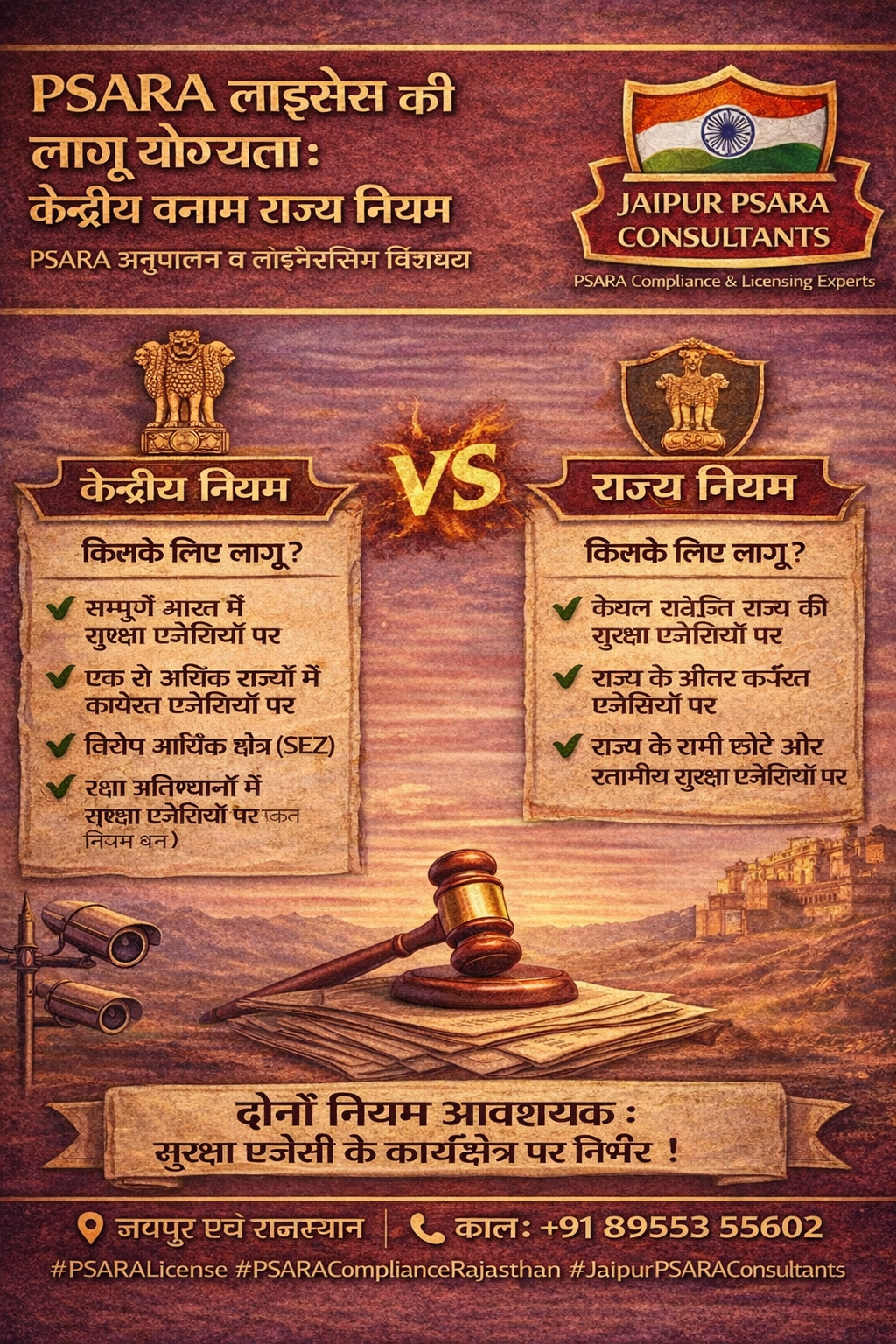
Understanding Central vs State PSARA Rules
The PSARA Act is a central law, but each state has the authority to frame state-specific rules for implementation. Here’s what you need to know:
1. Central PSARA Rules
- Issued by: Ministry of Home Affairs (Government of India)
- Scope: Provides the overall framework for licensing, training, and regulation of private security agencies across India.
- Key Points:
- Minimum eligibility criteria for agency owners
- Standardized guard training and certification
- Regulations for agency operations, documentation, and conduct
- Objective: Maintain uniform safety and operational standards across the country
Example:
A security agency operating in Delhi must comply with central PSARA rules for licensing, guard training, and agency conduct, even if local authorities have minor additional requirements.
2. State PSARA Rules
- Issued by: Individual State Governments under powers given by the PSARA Act
- Scope: States can adapt the central rules based on local requirements, including fees, documentation, and timelines.
- Common State Variations:
- Police verification requirements for guards
- License fees and renewal timelines
- Local inspections and reporting procedures
- Objective: Ensure compliance with central standards while addressing local law enforcement and operational realities
Example:
In Rajasthan, a Jaipur-based agency must follow central PSARA guidelines, but the state-specific rules include verification of office premises, additional documentation, and approval from the local licensing authority.
Real-Life Example
Let’s take the case of SecureShield Pvt. Ltd., a Jaipur-based security agency.
- Initial Scenario: They applied for a PSARA license without understanding Rajasthan-specific requirements.
- Outcome: Their application faced delays due to missing state-specific documents like office proof and local police verification.
- Solution: With guidance from top PSARA consultants in Jaipur, they were able to complete documentation, submit corrections, and get their license approved efficiently.
Lesson: Compliance with both central and state rules ensures faster approval and avoids legal issues.
PSARA License Process: Step-by-Step
For Jaipur-based agencies, the PSARA registration process typically involves:
- Eligibility Check: Ensuring the agency owner meets minimum requirements (age, background, and business experience).
- Documentation: Submission of:
- Proof of office premises
- Police verification certificates
- Financial statements
- Employee records
- Application Submission: Filing with the state licensing authority as per local rules
- Inspection & Verification: Physical verification of office and submitted documents
- License Approval: Issuance of PSARA license
- Renewal: License validity is generally 5 years; timely PSARA renewal ensures uninterrupted operations
Working with best PSARA consultants in Jaipur can simplify each step and prevent delays.
FAQs on PSARA License Applicability
Q1: Who needs a PSARA license?
A1: Any private security agency providing armed or unarmed guards must obtain a PSARA license.
Q2: Can PSARA rules differ between states?
A2: Yes, while the central framework is uniform, each state can add rules and requirements.
Q3: How long is a PSARA license valid?
A3: Typically 5 years. Renewal must be applied for before expiration.
Q4: What happens if I operate without a PSARA license?
A4: The agency may face fines, legal action, and closure of business.
Q5: How can I ensure smooth PSARA registration in Jaipur?
A5: Partnering with top PSARA consultants in Jaipur ensures proper documentation, compliance with both central and state rules, and timely approval.
Conclusion
Understanding the difference between central and state PSARA rules is crucial for private security agencies in India. While central rules maintain uniform standards for training and operations, state rules provide localized compliance measures, ensuring smoother enforcement and legal adherence.
For Jaipur-based agencies, working with top PSARA consultants in Jaipur can make the PSARA registration and renewal process seamless, save time, avoid penalties, and boost credibility with clients.
Remember, obtaining a PSARA license is not just a legal requirement—it’s a commitment to professionalism, safety, and trust in the private security industry.