Introduction
The private security industry in India has grown rapidly in the last decade. From corporate offices and malls to residential societies and industrial units, private security agencies play a crucial role in ensuring safety and discipline.
To regulate this growing industry and maintain quality standards, the Government of India introduced the Private Security Agencies Regulation Act (PSARA), 2005. One of the most important pillars of the PSARA Act is mandatory training for security guards and supervisors.
Many agencies believe that PSARA registration is only about paperwork and approvals, but in reality, training is a core requirement of the PSARA license process. Without proper training arrangements, your PSARA application may face rejection, delay, or even suspension during renewal.
In this detailed blog, we will explain the training requirements under the PSARA Act, their legal importance, real-life examples, common mistakes, and how top PSARA consultants in Jaipur can help you comply smoothly.
Understanding the Importance of Training Under the PSARA Act
Training is not just about physical drills; it is about building a professional, disciplined, and responsible security workforce.
Under the PSARA Act, private security agencies must ensure that their guards are trained to handle real-life security situations such as emergencies, crowd management, theft prevention, and crisis response.
Why the Government Emphasizes Training?
The government made training mandatory because:
- Untrained guards can create security risks
- Professional training improves public safety
- Standardized training ensures uniform quality
- Legal awareness reduces misuse of authority
- Skilled guards enhance the reputation of security agencies
This is why training is closely monitored during PSARA registration and PSARA renewal.
Legal Provisions Related to Training Under PSARA
According to PSARA rules:
- Every private security agency must provide training to its security personnel.
- Agencies must either have their own training facility (approved by authorities) or tie up with a recognized training institute.
- Proof of training arrangements must be submitted during PSARA registration.
- Training records must be maintained and produced during inspections and PSARA renewal.
Failure to comply with these provisions can result in PSARA rejection or suspension.
Detailed Training Requirements for Security Guards
1️⃣ Physical and Fitness Training
Security guards must undergo physical training to maintain fitness and discipline, including:
- Basic physical exercises and drills
- Endurance and stamina training
- Parade and discipline practices
Physical fitness is essential for guards to perform their duties effectively.
2️⃣ Basic Security Duties and Responsibilities
Guards must be trained in:
- Access control and visitor management
- Patrolling techniques
- Handling suspicious activities
- Protecting property and assets
This training helps guards understand their roles clearly.
3️⃣ Legal Awareness and PSARA Rules
Security personnel must learn:
- Basics of the PSARA Act
- Rights and limitations of security guards
- Legal consequences of misconduct
Legal awareness ensures that guards act responsibly and lawfully.
4️⃣ Fire Safety and Emergency Response
Training includes:
- Fire safety measures
- Use of fire extinguishers
- Evacuation procedures
- Emergency communication
This is crucial for handling emergencies in commercial and residential spaces.
5️⃣ First Aid and Disaster Management
Guards must be trained in:
- Basic first aid
- Handling medical emergencies
- Disaster response techniques
This training can save lives in critical situations.
6️⃣ Communication and Behavioral Skills
Security guards interact with clients, employees, and residents daily. Training includes:
- Communication skills
- Professional behavior and etiquette
- Conflict resolution
This improves service quality and customer satisfaction.
Training Requirements for Supervisors Under PSARA
Supervisors have greater responsibilities than guards. Their training includes:
- Leadership and team management
- Risk assessment and security planning
- Reporting and documentation
- Compliance with PSARA regulations
Supervisors act as a bridge between guards and management, so their training is equally important.
Duration of Training Under PSARA
The training duration varies depending on state rules, but generally:
- Security guards: 100–200 hours
- Supervisors: Additional advanced training
State governments may issue specific guidelines regarding training hours and curriculum.
Top PSARA consultants in Jaipur help agencies understand state-specific requirements during the PSARA license process.
Role of Training Institutes in PSARA Registration
Agencies must tie up with approved training institutes, such as:
- Government-recognized training centers
- NSDC or SSC-affiliated institutes
- State-approved security training organizations
During PSARA registration, agencies must submit:
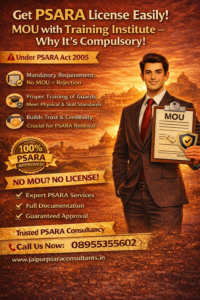
- MoU with training institute
- Training curriculum details
- Certificates or proof of training arrangements
This documentation is critical for PSARA approval.
Real-Life Examples of PSARA Training Compliance
📌 Example 1: Smooth PSARA Registration
A Jaipur-based security agency approached Jaipur PSARA consultants before applying for PSARA registration. They signed an MoU with a recognized training institute and prepared proper documentation.
✅ Result: Their PSARA license was approved without objections, and they started operations smoothly.
📌 Example 2: PSARA Rejection Due to Non-Compliance
Another agency applied for PSARA registration without proper training arrangements. During verification, authorities found that guards were untrained and no MoU was submitted.
❌ Result: PSARA application rejected, leading to financial losses and business delays.
📌 Example 3: Issues During PSARA Renewal
During PSARA renewal, an agency failed to provide updated training records of newly hired guards.
⚠️ Result: Renewal delayed, and the agency received a warning notice.
These examples clearly show why training compliance is crucial in the PSARA license process.
Common Mistakes Related to Training Under PSARA
Many agencies make avoidable mistakes, such as:
- Ignoring training requirements during PSARA registration
- Submitting fake or incomplete training certificates
- Not updating training records for new guards
- Not following state-specific training guidelines
- Poor documentation and record-keeping
To avoid these mistakes, it is advisable to consult the best PSARA consultants in Jaipur.
How Professional Consultants Help in PSARA Training Compliance
Professional consultants play a key role in simplifying the PSARA license process. They help agencies with:
- Identifying approved training institutes
- Drafting MoU agreements
- Preparing training-related documentation
- Ensuring compliance with PSARA rules
- Supporting PSARA renewal and amendments
Top PSARA consultants in Jaipur have in-depth knowledge of legal requirements and state-specific rules, which helps agencies avoid rejection and delays.
FAQs: Training Requirements Under the PSARA Act
❓ Is training compulsory for PSARA registration?
Yes, training is mandatory under the PSARA Act. Without training arrangements, PSARA registration cannot be approved.
❓ Can a security agency provide its own training?
Yes, but only if the training facility is approved by authorities. Otherwise, agencies must tie up with recognized training institutes.
❓ Is training required for existing guards?
Yes, all guards must be trained, including existing and newly recruited personnel.
❓ Is training checked during PSARA renewal?
Yes, training records are verified during PSARA renewal.
❓ How do Jaipur PSARA consultants help agencies?
Jaipur PSARA consultants guide agencies through training compliance and the complete PSARA license process.
Conclusion
Training requirements under the PSARA Act are not just legal formalities; they are the foundation of a professional and reliable security agency. Proper training ensures better service quality, legal compliance, and business growth.
Whether you are applying for PSARA registration or PSARA renewal, fulfilling training requirements is essential to avoid PSARA rejection or suspension.
To ensure a smooth and hassle-free PSARA license process, it is always recommended to work with top PSARA consultants in Jaipur who understand the complexities of the PSARA Act and provide end-to-end support.
By investing in proper training and expert guidance, security agencies can build trust, enhance their reputation, and achieve long-term success in the competitive security industry.